Solo Female Campervan Travel Europe: 2026 Safety Guide
Complete guide to solo female campervan travel in Europe — rental tips, safety strategies, best routes, overnight parking, and practical advice for 2026.
This post may contain affiliate links. Disclosure
There’s a particular kind of freedom that comes with turning a key, pulling onto an open European road, and knowing that your home is right behind you. Solo campervan travel through Europe has surged in popularity among women, and for good reason — it combines the independence of solo travel with the security of having your own private space, kitchen, and bed wherever you go.
Is campervan travel safe for solo women in Europe? It works because your home travels with you, but it raises questions couples never face. The guide covers vehicle types and rental companies, what to check before renting, choosing where to sleep, essential safety habits, apps every solo vanlifer needs, best European routes and budget planning.
But let’s be real: the idea of a woman alone in a van also raises safety questions that don’t apply to couples or groups. This guide addresses those concerns head-on while covering the practicalities of renting, routing, parking, and thriving on a solo campervan adventure across Europe in 2026.
Why Campervan Travel Works for Solo Women
The campervan solves several problems that solo female travelers face:
Privacy on demand. After a day of socializing at campsites or exploring towns, you close your door and you’re home. No shared hostel dorms, no awkward Airbnb check-ins, no negotiating boundaries with strangers.
Cost control. Campervanning eliminates separate accommodation and restaurant costs. You cook your own meals, sleep in your van, and your biggest daily expenses become fuel and campsite fees.
Flexibility. Don’t like a place? Drive to the next one. Found somewhere magical? Stay longer. The ability to change plans instantly is liberating.
Built-in safety features. You’re in a locked vehicle with the ability to move at any time. If a location feels wrong, you can be somewhere else within minutes.
That said, campervan travel requires more planning and mechanical confidence than hopping between hostels. The trade-off is worth it for women who value independence and aren’t intimidated by a bit of practical problem-solving.
Choosing and Renting Your Campervan
Types of Vehicles
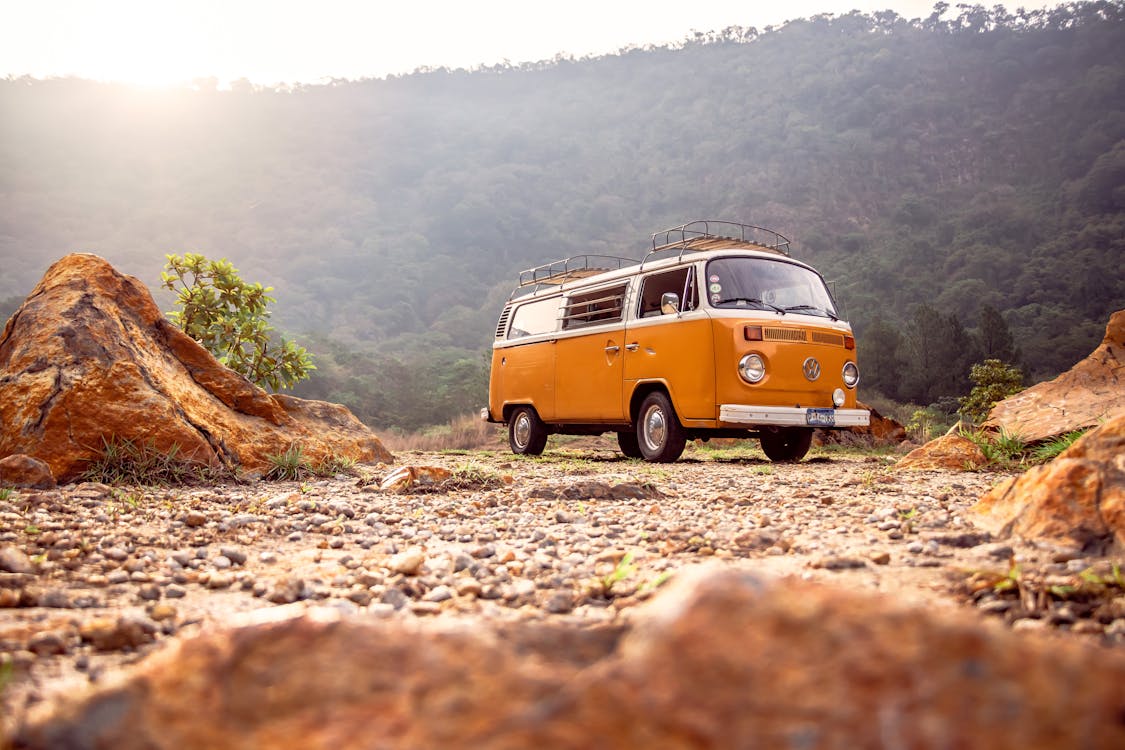
Converted vans (VW California, Mercedes Marco Polo, Ford Nugget): Compact enough for city driving, with pop-up roofs and integrated kitchens. Best for solo travelers who want maneuverability and don’t need much space.
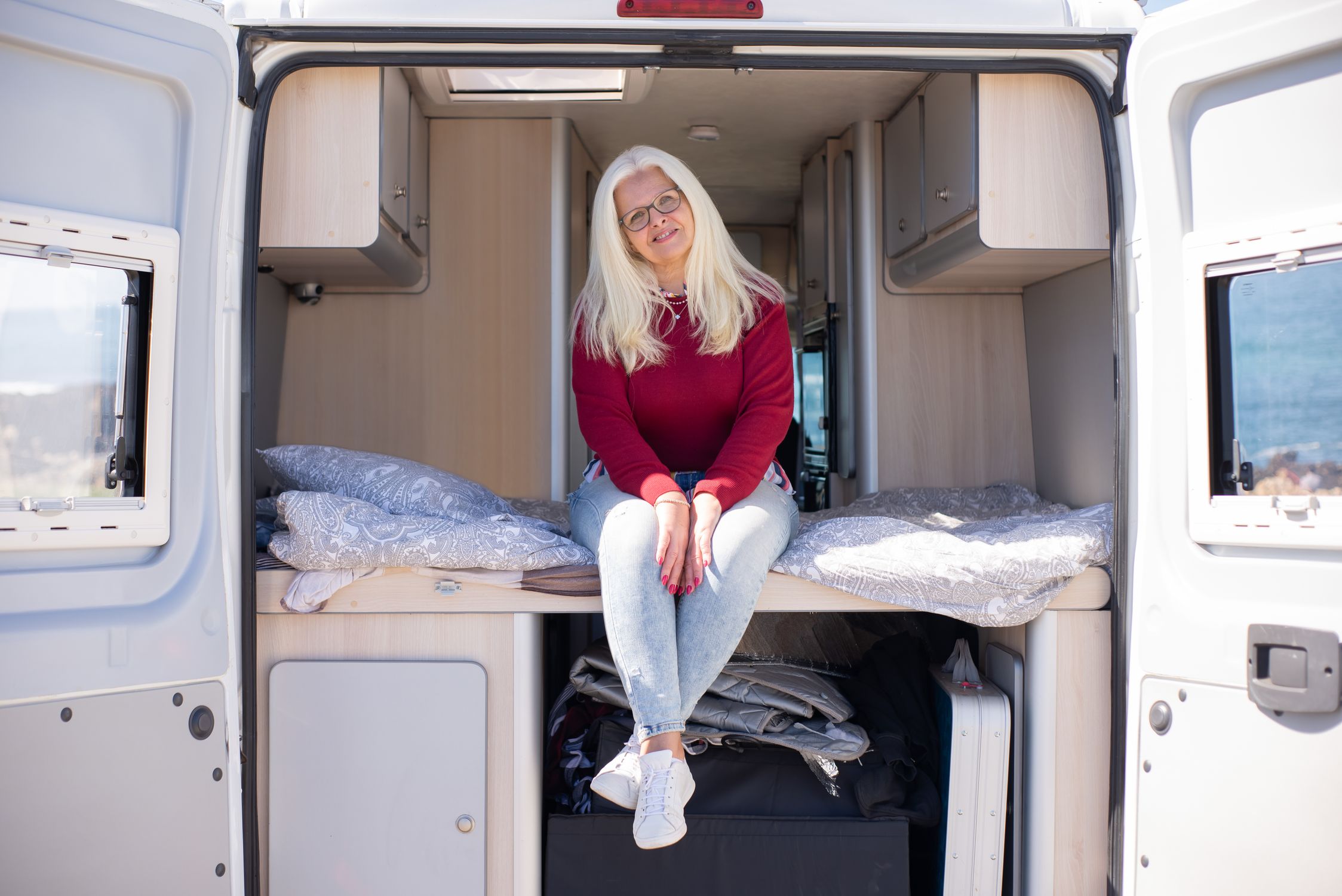
Small motorhomes (Fiat Ducato-based, 5-6 meters): More living space, standing room, and storage. Still manageable for one person to drive and park. The sweet spot for most solo female travelers.
Large motorhomes (7+ meters): More space than you need solo, and challenging to park and navigate in European towns. Generally overkill unless you’re planning a very long trip and want maximum comfort.
Rental Companies
Major European campervan rental companies include:
- Indie Campers: Available in 12+ European countries with modern vehicles and flexible pick-up/drop-off locations. Competitive pricing from around €60-90/day for a basic campervan
- Roadsurfer: Premium fleet, well-maintained, with stations across Germany, France, Spain, Portugal, and Italy
- Goboony: A peer-to-peer platform where you rent directly from private owners. Often cheaper than commercial rentals, and owners can share local tips
- Yescapa: Another P2P platform popular in France, Spain, and Italy
- Motorhome Republic: An aggregator that compares prices across multiple rental companies
What to Check Before Renting
- Insurance coverage: Ensure comprehensive insurance is included or available. Check the excess (deductible) — some companies charge high excess amounts that can be reduced with additional coverage
- Mileage limits: Some rentals include unlimited mileage; others cap daily kilometers with charges for overages
- One-way fees: If picking up in one country and dropping off in another, one-way fees can be significant. Plan accordingly
- Minimum age and license requirements: Most companies require drivers to be 21-25+ with a valid license. An International Driving Permit (IDP) is recommended in some countries
- Equipment included: Confirm what’s included — bedding, kitchen utensils, chairs, tables, GPS. Some companies charge extra for essentials
Safety Strategies for Solo Female Vanlifers
Safety is the number one concern for women considering solo campervan travel, and it deserves thorough attention. The good news: with smart habits, solo van travel in Europe is overwhelmingly safe. Here’s how experienced solo female vanlifers manage risk.
Choosing Where to Sleep
Your overnight parking choice is the most important safety decision you’ll make each day.
Campsites (safest option): Established campsites offer electricity, water, toilets, showers, and the security of other campers nearby. They range from basic municipal sites (€10-20/night) to full-service holiday parks (€25-50+/night). The social atmosphere also means natural opportunities to meet other travelers.
Designated motorhome areas (aires/stellplatz): Free or low-cost designated parking areas for motorhomes, particularly common in France (aires), Germany (stellplätze), and Spain (áreas). Many have basic facilities. Choose spots where other campervans are already parked.
Wild camping/free parking: Legal in some countries (Scotland, Scandinavia under “Right to Roam” laws), tolerated in others, and illegal in some. If free parking, follow these rules:
- Never park somewhere completely isolated — look for places where other campervans are present
- Arrive late, leave early
- Choose well-lit, flat areas with no signs prohibiting overnight stays
- Trust your gut — if a spot feels wrong, drive on
Essential Safety Habits
Share your location. Use WhatsApp’s live location feature or a GPS tracker app to share your real-time position with a trusted contact. Check in every 24-48 hours via text or voice message.
Lock everything. Lock all doors and windows when sleeping and when leaving the van. Consider a steering wheel lock and wheel clamp — they deter theft and prevent the van from being moved while you sleep.
Window coverings are non-negotiable. Install blackout curtains or reflective window covers on every window. From outside, no one should be able to tell if someone is inside or determine your gender.
Park strategically. Position your van so you can drive away quickly without reversing. Back into spots when possible so you can pull straight out.
Minimize solo-traveling signals. Some women place a pair of men’s boots near the door or hang a large jacket visible through the windshield. Others find this unnecessary but worth mentioning as a common practice.
Keep essentials accessible. Phone, keys, shoes, and a flashlight should be within arm’s reach when you sleep. If something feels off, you want to be able to drive away within seconds.
For a comprehensive overview of safety equipment, check our guide to solo female van life safety gear and personal safety devices for women travelers.
Apps Every Solo Female Vanlifer Needs
- Park4Night: Community-reviewed overnight spots across Europe. Filter by safety ratings, facilities, and user photos
- iOverlander: Particularly good for remote or off-the-beaten-path park-ups
- Google Maps/Maps.me: Download offline maps for areas with poor cell coverage
- Grab/local ride-hailing apps: For times you want to explore a city without driving the van in
- Campsite booking apps: Campingcard ACSI, Pitchup, and Camping.info for finding and booking campsites
Best European Routes for Solo Female Vanlifers
Portugal’s Atlantic Coast (2-3 weeks)
Route: Lisbon → Sintra → Nazaré → Porto → Douro Valley → Algarve
Portugal is arguably the best country in Europe for campervan beginners. The climate is mild year-round, campsite infrastructure is excellent, wild camping is tolerated in many coastal areas, and Portugal ranks 7th globally on the Global Peace Index. The Algarve coast offers stunning cliffs and hidden beaches, while Porto and the Douro Valley deliver culture and world-class wine.
Scandinavia’s Coastal Roads (3-4 weeks)
Route: Oslo → Bergen → Norwegian fjords → Lofoten Islands → Swedish coast → Copenhagen
The “Right to Roam” (Allemannsretten) in Norway and Sweden makes free overnight parking legal almost everywhere, as long as you’re respectful of private property and nature. The safety levels in Scandinavian countries are among the highest in the world, making this an excellent choice for women traveling alone. The trade-off: higher fuel and food costs.
Spain and France Mediterranean Loop (3-4 weeks)
Route: Barcelona → Costa Brava → French Riviera → Provence → Languedoc → Andalusia
The Mediterranean coastline offers warmth, excellent food, and well-developed campervan infrastructure. France’s aire system is particularly convenient, with thousands of free or low-cost motorhome parking areas. Spain’s campervan culture is thriving, with active communities and meetups.
Scotland and Ireland (2-3 weeks)
Route: Edinburgh → Scottish Highlands → Isle of Skye → Outer Hebrides → ferry to Northern Ireland → Wild Atlantic Way
Scotland’s wild camping law allows you to park virtually anywhere responsibly. The Highland landscapes are among Europe’s most dramatic, and the small communities along the way are welcoming and safe. Ireland’s Wild Atlantic Way is one of the world’s great coastal drives.
The Balkans (3-4 weeks)
Route: Slovenia → Croatian coast → Montenegro → Albania → North Macedonia → Bosnia
For adventurous vanlifers on a budget, the Balkans offer incredible value. Fuel, food, and campsites cost a fraction of Western European prices, and the scenery — from Montenegrin fjords to Albanian riviera beaches — is extraordinary. Infrastructure is developing rapidly, though road conditions can be challenging in rural areas.

Daily Life on the Road
Cooking and Food
One of campervan travel’s greatest pleasures is shopping at local markets and cooking with regional ingredients. A basic van kitchen (two-burner stove, small fridge, basic utensils) handles most meals easily. Stock up on staples at supermarkets and fresh produce at farmers’ markets.
Meal planning tips:
- One-pot meals are your best friend — pasta, stews, stir-fries, and curries all work on a two-burner stove
- Pre-prep ingredients during downtime so cooking is fast at the end of the day
- Keep snacks accessible for driving days — nuts, fruit, cheese, and bread
- Stock up before weekends and public holidays when shops may close
Water and Power
Fresh water: Most campsites and motorhome service areas have water fill-up points. Carry a 10-20 liter portable container as backup. Use bottled or filtered water for drinking in Southern and Eastern Europe.
Electricity: Campsite hook-ups charge your batteries and power devices. For off-grid parking, a portable solar panel (100-200W) keeps phones, laptops, and lights running. Most modern rental vans include a leisure battery that charges while driving.
Toilets: Some vans have built-in cassette toilets; others rely on campsite facilities. If free camping, know the location of nearby public toilets. Never use nature as a toilet in populated areas — it’s disrespectful and in many countries, illegal.
Laundry
Campsites usually have washing machines (€3-6 per load). Between campsites, hand-wash essentials in a basin and dry on a line stretched from your van’s mirrors. Pack quick-dry clothing to make this easier.
Budget Planning
Solo campervan travel in Europe is surprisingly affordable when you factor in combined savings on accommodation and food.
Daily budget estimate (excluding van rental):
- Fuel: €20-40/day depending on driving distance and fuel prices
- Campsite fees: €15-25/night (less if using free aires or wild camping)
- Food: €15-25/day cooking most meals, with occasional restaurant meals
- Activities/attractions: €10-20/day average
- Total: €60-110/day
Van rental: €50-120/day depending on vehicle size, season, and rental company. Longer rentals (3+ weeks) offer significant per-day discounts.
Money-saving strategies:
- Travel in shoulder season (May-June or September-October) for lower rental rates and campsite fees
- Use the aire/stellplatz network extensively — many are free
- Cook 80% of your meals in the van
- Fuel up at supermarket petrol stations (Carrefour, Leclerc, Lidl) rather than motorway stations
For more budget strategies, our budget solo travel guide and backpacking Europe on a budget have transferable tips.
Common Concerns Addressed
“I’ve never driven a large vehicle.” Most rental companies offer a brief orientation. Compact campervans (under 6 meters) drive similarly to large SUVs. Practice in a parking lot before hitting the road. Remember: you don’t need to parallel park a campervan — you just need to pull into designated spaces.
“What if something breaks down?” Rental companies provide roadside assistance. Save the emergency number in your phone and know your policy’s coverage. Keep a basic toolkit, a tire pressure gauge, and jump cables in the van.
“Will I be lonely?” Campsite culture is inherently social. Fellow campers strike up conversations, share tips, and often invite you for evening drinks. Solo female vanlifers frequently report that the campervan community is one of the friendliest travel subcultures. Join Facebook groups like “Solo Female Vanlife Europe” for meetups and convoy opportunities.
“What about driving in cities?” Don’t. Park your van at a campsite or designated area outside the city center and use public transport, bikes, or ride-hailing apps to explore urban areas. Driving a campervan through narrow European city streets is stressful and unnecessary.
When to Go
- May-June: Ideal conditions — warm but not scorching, longer days, pre-peak season pricing
- July-August: Peak season. Warmer, busier, more expensive. Book campsites in advance
- September-October: Excellent weather in Southern Europe, golden light, thinning crowds. Arguably the best time overall
- November-April: Possible in Southern Europe (Portugal, Spain, southern France, Greece) but cold and limited in Northern Europe. Fewer facilities open, but dramatic solitude
Packing Essentials
Beyond what the rental van provides, bring:
- A headlamp (hands-free lighting for evening setup)
- A portable Bluetooth speaker (for music and podcasts)
- A quality sleeping bag or blanket (rental bedding varies)
- Insect repellent and a mosquito net for summer
- A daypack for hikes and city exploring
- Basic tools: duct tape, zip ties, multi-tool
- A portable Wi-Fi hotspot or local SIM/eSIM — our travel eSIM guide covers European options
For a complete packing strategy, check our carry-on packing system for women — adapted for van life, the principles are the same: pack less, choose versatile items, and prioritize function.
Final Thoughts
Solo female campervan travel in Europe isn’t reckless or foolish — it’s one of the most empowering ways to see the continent. You set the pace, choose the views, cook what you want, and sleep where you decide. The combination of freedom and self-reliance builds a confidence that transfers to every other area of your life.
Yes, it requires more planning than booking a hostel. Yes, you need to be vigilant about safety. But thousands of women do this every year and overwhelmingly report the same thing: it was one of the best experiences of their lives.
The road is open. Your van is waiting.
Get price-drop alerts and new guides from HerTripGuide
One email a week: price drops on the gear we recommend, new guides, and what changed. No spam, unsubscribe anytime.