Solo Female Camping: The Beginner's Honest Guide 2026
Complete beginner's guide to solo female camping in 2026: campsite selection, safety tips, essential gear (tent, sleep system, cook kit), best campgrounds, and essential apps.

This post may contain affiliate links. Disclosure
Solo female camping has one of the steepest perception-versus-reality gaps in all of outdoor adventure. The perception: camping alone as a woman is dangerous, uncomfortable, and probably involves bears. The reality, reported by millions of women who do it regularly: it is one of the most genuinely empowering, peaceful, and confidence-building experiences available, with risks that are entirely manageable through reasonable preparation.
The data supports this optimism. Women camping alone are far more likely to encounter an overly curious raccoon than a threatening human. Designated campgrounds — particularly those run by state, provincial, or national park systems — have good safety records and staff available for assistance. The biggest genuine risks are environmental rather than human: weather changes, dehydration, getting lost on trails — all of which advance preparation addresses directly.
This guide is built for complete beginners: women who have never camped solo before and want to understand exactly what gear they need, how to choose a safe campsite, and how to manage the practical and psychological realities of sleeping outdoors alone for the first time. If you are working through solo travel anxiety more broadly, our solo travel mental health guide has a practical framework that applies directly to first-night camping nerves.
Key Takeaway: Solo female camping is genuinely safe and accessible for beginners who invest in appropriate gear, choose established campgrounds for their first experiences, and develop basic navigation and weather awareness before heading out.
Before Your First Solo Camp: Building Confidence Gradually
The most common mistake first-time solo female campers make is attempting too much too soon. Starting with a single night at a busy, well-facilitated campground — ideally within an hour of home — and building from there is dramatically more likely to result in a positive first experience than immediately attempting a multi-day backcountry solo.
The confidence-building progression:
- Car camping at a busy established campground (close to facilities, neighbors visible, cell service available). This gives you the core experience — setting up your tent, cooking outdoors, sleeping outside, waking up to birds — without wilderness risk.
- Car camping at a quieter campground (fewer neighbors, lower cell service, more self-reliance required). One to two nights.
- Dispersed camping on public land (BLM or National Forest in the US; Crown Land in Canada; equivalents elsewhere) — no facilities, requiring self-sufficient water, waste disposal, and navigation.
- Overnight backpacking — carrying everything on your back, camping away from road access.
- Multi-day backcountry travel — the full independence of wilderness solo camping.
Each step builds skills and confidence that make the next step comfortable rather than terrifying. Most women who end up loving solo camping took six to twelve months working through this progression.
Campsite Selection: The Safety-First Framework
Where you camp matters enormously for both safety and quality of experience. Here is a practical framework for evaluating campsites.
For beginners: designated campgrounds only
Established campgrounds run by national parks, state parks, provincial parks, or reputable private operators (KOA, Hipcamp-listed properties) offer:
- Camp hosts or rangers on-site or on-call
- Other campers nearby
- Defined emergency procedures
- Cell service or at minimum a satellite phone available through staff
- Basic facilities (water, toilets, often showers)
Book established campgrounds in advance — popular sites in national parks can be fully booked months ahead for summer weekends. Recreation.gov (US national park camping), Reserve California, Reserve America, and the Parks Canada reservation system all allow advance booking. When reading reviews before booking, look specifically for mentions of how busy it gets, any security concerns, wildlife encounters, and how responsive the camp host is.
For all experience levels: evaluating a campsite on arrival
When you arrive at a campsite — whether designated or dispersed — run through this quick assessment:
Escape routes: Know how to exit quickly if needed. Your car should be parked facing the exit.
Visibility: Choose sites that are not isolated in ways that hide you from view while simultaneously being somewhat set back from high-traffic paths.
Natural hazards: Avoid dry riverbeds (flash flood risk), dead trees overhead (widow-makers), and low-lying ground (water collection in rain).
Neighbors: At designated campgrounds, neighbors are a safety asset. Choose a site with other campers nearby, particularly as a beginner. Introduce yourself to neighbors when you arrive — a brief hello creates a watch-out-for-each-other dynamic.
Cell coverage: Check your phone signal on arrival. If there is no service, note the nearest point where you had coverage and consider downloading offline maps before you lose connection.
Who is around you: Be aware of what is going on in neighboring sites and how that changes throughout the day. A camp host you can approach in an emergency is worth knowing about when you arrive.
Essential Camping Gear: What You Actually Need
Camping gear marketing is overwhelming for beginners, and the gear industry’s price points range from affordable to genuinely ridiculous. Here is an honest breakdown of what you actually need for safe, comfortable solo camping — with realistic price guidance.
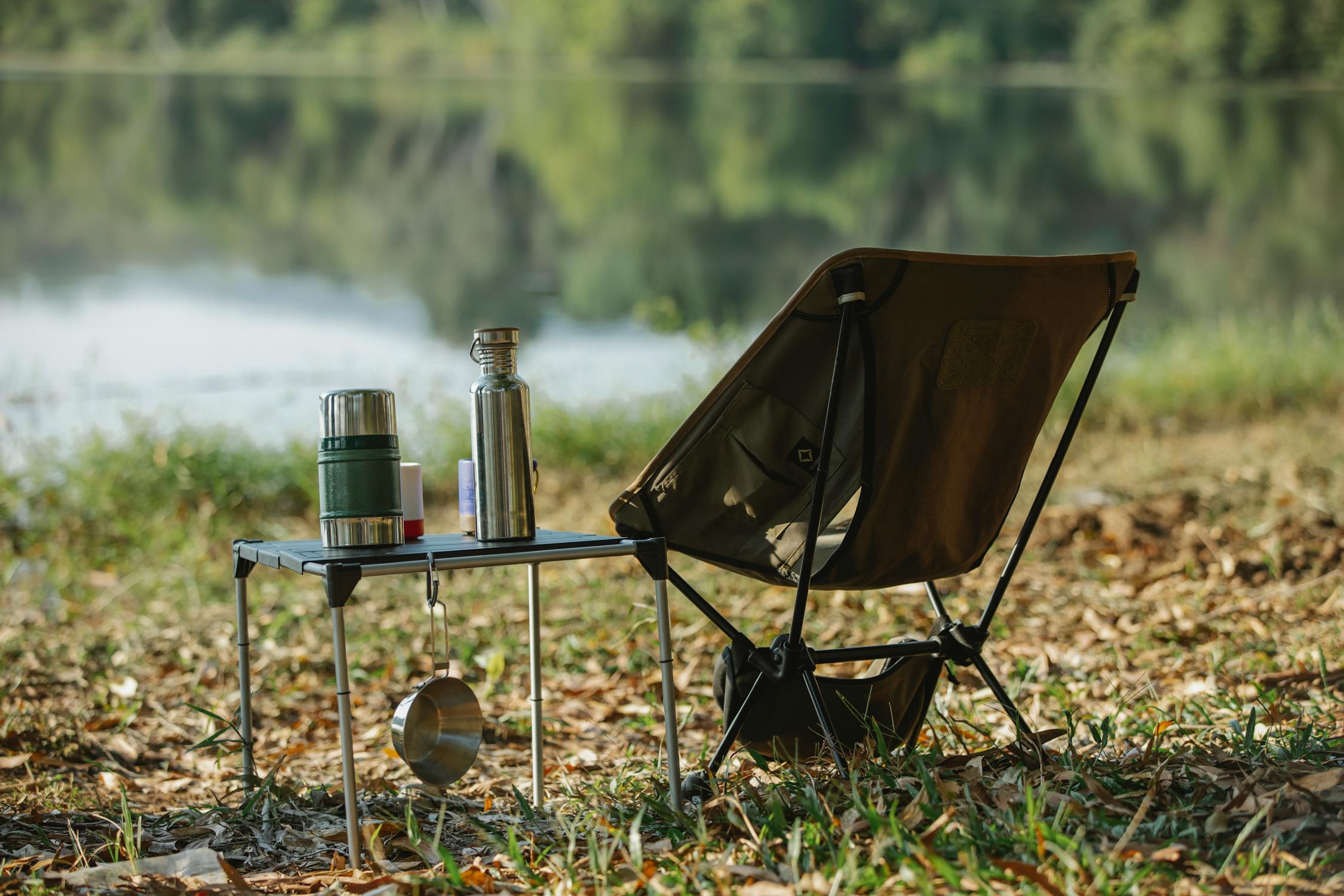 Photo credit on Pexels
The Tent: Your Home Outside
Your tent is your most important gear investment. For solo camping, a quality one-person or two-person tent gives you:
- One-person tent: lighter and more compact (important for backpacking), but can feel cramped with all your gear inside
- Two-person tent: roomier, easier to manage gear and clothing inside, slightly heavier
Go for a freestanding tent — that way, you are not stuck searching for perfect trees or level ground. Freestanding tents are also easier to set up solo, which matters when you arrive at camp tired.
What to look for:
- Double-wall construction (inner mesh tent + separate waterproof rainfly) for condensation management
- Full coverage rainfly that extends to the ground
- Freestanding design (stakes optional — important if you camp on rocky ground)
- Minimum 1,500mm hydrostatic head rating for the floor (higher is better for wet conditions)
- Good reviews specifically from women camping solo (interior space, ease of setup alone)
Recommended options:
- Budget: REI Passage 1 (~$150) or similar — good quality at accessible price
- Mid-range: MSR Hubba Hubba Tent (~$300-350) — excellent durability and weather resistance
- Ultralight backpacking: Big Agnes Copper Spur HV UL1 (~$400-500) — superb for those who progress to backpacking
The Sleep System: Staying Warm and Comfortable
The sleep system is your sleeping bag and sleeping pad together — they work as a unit, and underinvesting in either one results in cold, uncomfortable nights.
Sleeping bags: Rated by temperature. For three-season camping (spring/summer/fall), a bag rated to 20°F (-7°C) or 0°F (-18°C) handles most conditions with appropriate base layers. Women-specific bags have more insulation in the footbox and hip area, which genuinely matters because women tend to sleep colder than men. Look for bags specifically marketed as “women’s” versions.
Recommended: REI Magma Women’s 15 (~$300) or Kelty Cosmic Women’s 20 (~$100) for a budget option.
Sleeping pads: Provide insulation from the ground (even more important than a sleeping bag for preventing heat loss to cold ground) and cushioning. R-value is the insulation rating — aim for R-4 or higher for three-season camping.
- Foam pads: cheapest and most durable, but bulky. Therm-a-Rest Z Lite Sol (~$50) is the gold standard.
- Inflatable pads: much more comfortable and packable, more expensive. Sea to Summit Comfort Plus Insulated (~$200-250) is an excellent women’s option.
The Cook Kit: Eating Well Outdoors
Cooking outside is one of the great joys of camping, and a basic cook kit does not need to be expensive or complicated.
Stove: A canister stove (Jetboil Flash Cooking System, MSR PocketRocket, or similar) is the easiest option for beginners — simply screw onto a standard isobutane fuel canister and ignite. The Jetboil Flash (~$100-120) is particularly beginner-friendly for solo cooking because it boils water incredibly fast and the pot doubles as a drinking vessel.
Cookware: A lightweight titanium or aluminum pot (600-900ml for solo cooking) handles most camp meals. Many solo travelers do well with just the Jetboil system or a single pot plus lid.
Food strategy: Freeze-dried meals (Mountain House, Backpacker’s Pantry) are the most convenient option — just add boiling water, wait five minutes, eat. They are expensive ($10-15 per meal) but require zero additional equipment. For car camping with more weight tolerance, a small cast iron skillet opens up significantly more cooking options.
The 10 Essentials: Never Skip These
No matter how short or simple your camping trip, always carry: navigation tools (map, compass, and downloaded offline map on your phone), sun protection, headlamp with spare batteries, basic first-aid kit, fire starters, repair kit and tools, emergency shelter, extra food, extra water, and insulation beyond what you expect to need.
Safety at Camp: Practical Strategies That Actually Work
Tell someone your plan. Before every camping trip, give a trusted person your campsite name and reservation number, your planned arrival and departure dates, your trailhead location if doing any hiking, and a clear instruction about when to call for help if they have not heard from you. This is the single most important safety practice for solo camping.
Invest in a personal locator beacon or satellite communicator. In areas with no cell service, a Garmin inReach Mini 2 ($350 device + $15-25/month subscription) or ACR ResQLink PLB ($250, no subscription required but one-way SOS only) provides emergency communication capability. The inReach allows two-way text messaging via satellite — meaning you can check in with your safety contact daily without cell service.
Carry basic safety tools. Bear spray, a whistle, and a reliable headlamp should always be accessible when you are in camp or on the trail. Trust your instincts — if a situation or location feels unsafe, pack up and leave. Safety is always the priority, and no campsite is worth staying in if it feels wrong.
Store food properly. Food odors attract wildlife. At established campgrounds, use the bear boxes provided. In dispersed camping or backcountry settings, use a bear canister (required in many wilderness areas) or hang your food bag at least 10 feet high and 4 feet from the tree trunk. This applies to all food, trash, and scented items including toothpaste and lip balm.
Lock your car and secure valuables. At established campgrounds, theft is the more likely threat than wildlife. Keep valuables in your car, lock the car when you leave the site, and do not leave cameras, phones, or expensive gear visible through windows.
Sleeping soundly: Psychological comfort at night is a real consideration for new solo campers. Strategies that help: a small battery-powered lantern inside your tent creates a sense of light and warmth; knowing your campground layout before dark; identifying the nearest bathrooms and camp host location before settling for the night; and keeping a headlamp and phone within arm’s reach while sleeping.
Best Apps for Solo Female Campers
The Dyrt: The most comprehensive campsite database for US camping, with user reviews, photos, and filtering by fee, hookups, cell service, and amenities. Premium subscription ($35/year) adds offline maps and trip planning tools.
AllTrails: Essential for any hiking component of your camping trip. Download offline maps for your destination before leaving cell service. Provides difficulty ratings, recent user reviews, and photos of current trail conditions.
Weather.gov or Windy.com: Always check the detailed hourly forecast for your specific campsite area, not just the general regional forecast. Mountain weather and coastal weather particularly require site-specific checking. The Windy.com app provides 3D weather visualization that is excellent for understanding weather patterns moving through an area.
iOverlander: Best for dispersed camping and overlanding, with community-sourced site reviews that include current conditions and safety notes.
Garmin Connect (with inReach device): For tracking and check-in messaging when camping off-grid.
Best Beginner-Friendly Campgrounds for Solo Women
Yosemite National Park, California: The infrastructure is excellent, the scenery is extraordinary, and the camping community at campgrounds like Upper Pines creates a natural safety network of neighboring campers. Book far in advance — Yosemite reservations open five months ahead and fill within minutes for summer dates.
Shenandoah National Park, Virginia: An excellent choice for beginners on the East Coast. Ranger stations are nearby, campsites are clearly marked, and the Skyline Drive makes the park highly accessible. Frontcountry campgrounds have bathrooms, water, and other campers around — you get all the benefits of outdoor camping without feeling remote.
Acadia National Park, Maine: Blackwoods and Seawall campgrounds offer excellent facilities in one of the East Coast’s most beautiful national parks. The compact size of Acadia makes it very manageable for beginners — trails are well-marked and you are never far from the campground.
Pictured Rocks National Lakeshore, Michigan: For solo women interested in progressing to wilderness camping, the Pictured Rocks backcountry permit system provides a managed wilderness camping experience with designated sites, bear boxes, and ranger oversight — all in genuinely spectacular scenery along Lake Superior.
Banff and Jasper National Parks, Canada: World-class infrastructure, extraordinary scenery, and the Canadian national parks reservation system works efficiently. Note that Banff is expensive for park fees and campsite fees relative to US national parks.
 Photo credit on Pexels
For gear reviews that overlap with camping — particularly if you are also considering a solo road trip that combines camping with driving — our solo female road trip guide covers the overlapping equipment categories in additional detail. And if you are drawn to longer-form outdoor adventures after your first camp nights, the solo female hiking national parks guide is the natural next step.
Related Reading
Get the best HerTripGuide tips in your inbox
Weekly guides, deals, and insider tips. No spam, unsubscribe anytime.