Budapest Solo Female Travel Guide
Everything solo women need to know about Budapest: safest neighborhoods, getting around, budgets, and where to stay.

Budapest, Hungary

About Budapest
Budapest is the capital and most populous city of Hungary. It is Hungary's primate city with 1.7 million inhabitants and its greater metro area has a population of about 3.
Read more on WikipediaQuick Facts
Safety score derived from the U.S. State Department Travel Advisory for Hungary: Level 1 (Exercise Normal Precautions), as of 2026-07-08. Country-level guidance; check local conditions before you go.
Welcome to Budapest
 Photo: Hungarian Parliament 031 - Flickr - granada turnier.jpg by granada_turnier (CC BY 2.0), via Wikimedia Commons
Hey there, wander‑woman! If you’re looking for a city that feels both grand and intimate, Budapest is ready to welcome you with open arms. It’s the capital and largest city of Hungary, perched at 47.4925° N, 19.0514° E, and home to roughly 1.8 million people — a size that feels bustling enough for endless discovery but still easy to navigate on your own — according to Wikipedia – Budapest.
From the soothing steam of historic thermal baths to the glittering lights along the Danube, Budapest blends old‑world charm with a vibrant, modern pulse. As a solo female traveler, you’ll find the city’s mix of safety, convenience, and cultural richness perfect for exploring at your own pace. Let’s dive into the neighborhoods that will become your playground, the sights worth building a day around, the ways to zip around town confidently, and the practical tips that keep your adventure smooth and secure.
Neighborhoods to Know
Castle District (I. kerület)
 Photo: 20190502 Baszta Rybacka w Budapeszcie 1029 1974 DxO.jpg by Jakub Hałun (CC BY-SA 4.0), via Wikimedia Commons
Perched high above the river, the Castle District feels like stepping into a storybook. This UNESCO World Heritage area is home to Buda Castle and Fisherman’s Bastion, with sweeping views over the Danube and Pest skyline. The cobblestone streets, historic museums, and cozy cafés make it an ideal base for early mornings and sunset strolls. Because it’s a popular spot with tourists and locals alike, you’ll always have fellow travelers nearby, adding an extra layer of comfort when you’re out alone.
Jewish Quarter (VII. kerület)
 Photo: 2017 Central Synagogue towers.jpg by Beyond My Ken (CC BY-SA 4.0), via Wikimedia Commons
If you’re craving nightlife that buzzes with creativity, the Jewish Quarter is your go‑to. Home to the Dohány Street Synagogue — the largest synagogue in Europe — and famous “ruin bars” like Szimpla Kert, this area stays lively well into the early hours. The constant flow of locals and visitors creates a natural safety net, and the central location means you’re never far from public transport or a friendly face. Whether you’re sipping a craft cocktail in an eclectic courtyard or exploring street art, you’ll feel both energized and secure.
Andrássy Avenue (VI. kerület)
 Photo: Hungarian State Opera House. Giuseppe Verdi & Gounod (Pál Pátzay), - Budapest District VI. Andrássy Ave 22.jpg by Globetrotter19 (CC BY-SA 4.0), via Wikimedia Commons
Imagine a boulevard that feels like a museum walk‑through — that’s Andrássy Avenue. This elegant, UNESCO‑listed stretch is lined with grand museums, the Hungarian State Opera House, upscale shops, and historic architecture. It’s popular for daytime explorations and evening promenades, with wide, well‑lit sidewalks that give you plenty of space to wander. The abundance of cafés offers perfect pause points for people‑watching or a quick journal entry.
Top Things to Do in Budapest
Sister, once you’ve settled into a neighborhood, here’s where to actually spend your days.
1. Hungarian Parliament Building
Sitting right on the Danube’s Pest bank, this is one of Europe’s oldest legislative buildings and Hungary’s largest building. Guided interior tours run daily and book up fast in peak season, so reserve ahead if you want to see the crown jewels up close.
2. Fisherman’s Bastion
This neo-Romanesque terrace on Castle Hill was built in the early 1900s purely for the view, and it delivers — sweeping panoramas over the Danube and Pest’s skyline. It sits right inside the Castle District, so you can wander over on foot and catch golden-hour light without arranging any transport.
3. Buda Castle
The historic palace complex of the Hungarian kings anchors the Castle District and now houses the Hungarian National Gallery and Budapest History Museum. It pairs naturally with Fisherman’s Bastion for a single, easy solo morning on the hill.
4. Dohány Street Synagogue
The largest synagogue in Europe, this Moorish Revival landmark in the Jewish Quarter also houses the Hungarian Jewish Museum and a moving memorial garden. Guided tours are widely available and give real historical context to the neighborhood you’ll likely be staying near.
5. Széchenyi thermal bath
One of the largest bath complexes in Europe, Széchenyi’s bright yellow Neo-Baroque building and outdoor thermal pools are a Budapest rite of passage. It’s a genuinely comfortable solo activity — locals and travelers alike come to soak alone, and you’ll likely strike up conversation in the outdoor pools.
6. Széchenyi Chain Bridge
The first permanent bridge across the Danube connecting Buda and Pest, this 19th-century suspension bridge is at its most magical lit up after dark. Walking across it links the Castle District directly to downtown Pest.
7. Heroes’ Square
One of Budapest’s major squares, marked by the Millennium Monument honoring the leaders of the Hungarian tribes, sits at the end of Andrássy Avenue next to City Park. It’s an easy, walkable finish to an Andrássy Avenue afternoon.
Book tickets & skip-the-line tours: Browse Budapest experiences
Getting Around
 Photo: Budapest yellow tatra tram.jpg by Bryce Edwards from London, United Kingdom (CC BY 2.0), via Wikimedia Commons
Budapest’s public‑transport network is the city’s circulatory system, and it works like a charm. Metros, trams, and buses criss‑cross the metropolitan area, providing reliable and inexpensive options for getting from one neighborhood to another — according to Wikipedia – Budapest.
- Metro: Four color‑coded lines run like arteries through the city, stopping at major attractions and transport hubs.
- Trams: The iconic yellow trams glide along the riverbanks and through historic districts, offering scenic rides that double as sightseeing tours.
- Buses: Night buses keep the city moving after the metro closes, ensuring you’re never stranded.
If you prefer a door‑to‑door ride, taxis are safest when you book them through the Bolt app rather than flagging one on the street. The app gives you a clear price upfront and tracks the vehicle, adding an extra layer of peace of mind.
Safety & Practical Notes
The U.S. State Department rates Hungary Level 1 (Exercise Normal Precautions) (as of 2026-07-08). Traveling solo as a woman can feel daunting, but Budapest’s safety landscape is reassuring: violent crime is rare, and the city is widely considered one of the safer capitals in Europe for solo travelers. The everyday risks are the ordinary ones — pickpocketing in crowded tourist spots and tram stations, and the occasional overpriced bar bill or rigged taxi rather than anything more serious.
Here are a few sister‑to‑sister tips to keep your confidence high:
- Stay in well‑lit, populated areas at night. The Castle District, Jewish Quarter, and Andrássy Avenue all have active street life after dark, which naturally deters trouble.
- Keep your belongings close. Pickpocketing can happen in crowded spots like tram stations or popular bars, so a cross‑body bag with a zippered front pocket works wonders.
- Use the Bolt app for taxis. Booking through the app reduces the risk of unlicensed drivers and gives you a digital receipt.
- Know the emergency number. Hungary’s general emergency line is 112, reachable from any phone.
When it comes to everyday comforts, Budapest’s tap water is safe to drink, and the city uses the European standard plug type (C and F).
Best Time to Visit
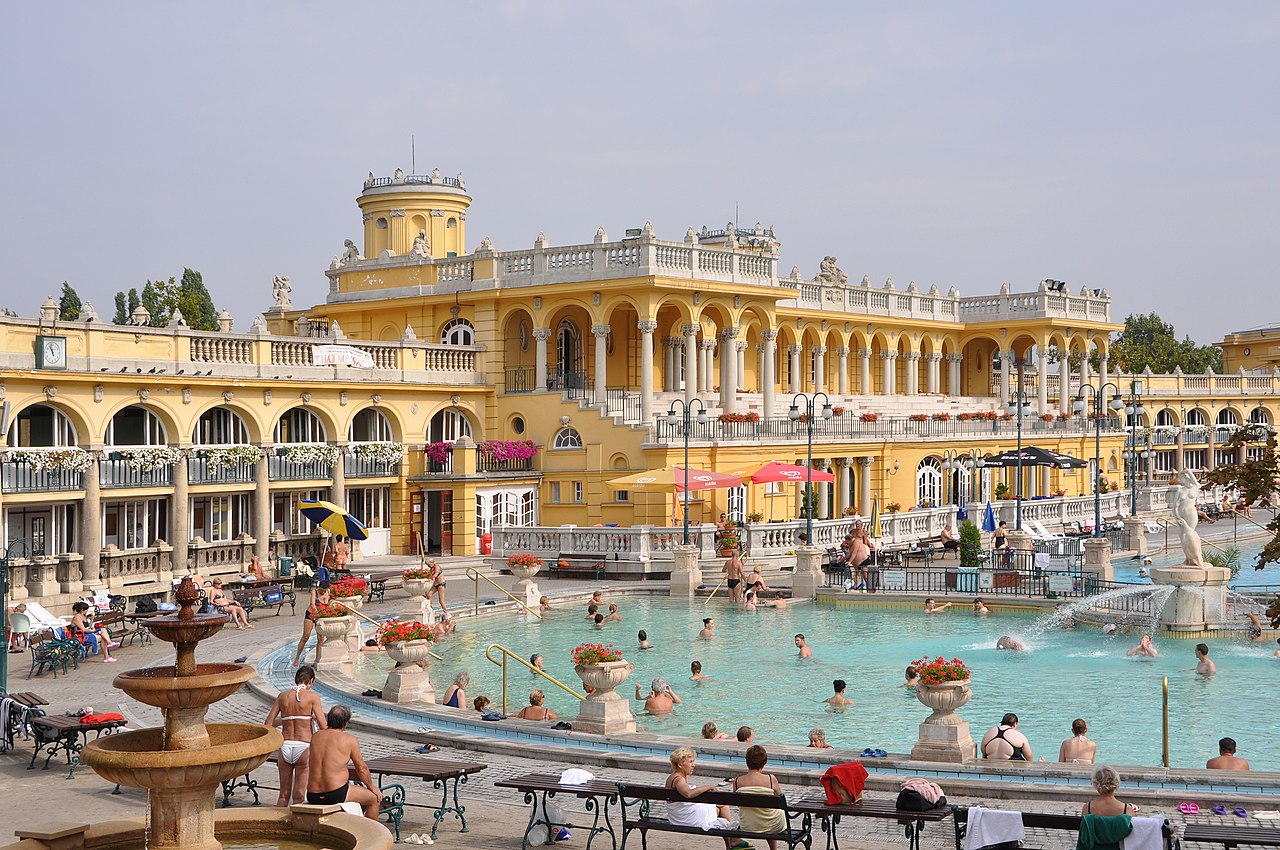 Photo: Budapest Széchenyi Baths R01.jpg by Marc Ryckaert (MJJR) (CC BY 3.0), via Wikimedia Commons
Budapest has a continental climate, with warm summers and crisp winters. Late spring (May) and early fall (September) hit the sweet spot — mild temperatures for walking between neighborhoods, without the peak-summer crowds around the Castle District and thermal baths. Winter has its own appeal too: the outdoor pools at Széchenyi stay open (and steaming) year-round, and Budapest’s Christmas markets are among the prettiest in Central Europe.
Where to Stay
 Photo: Art Nouveau residential house with beautiful wrought iron balcony grilles and decorative flower ornamentation. Monument ID 7962 Restaurant. - Budapest District VII. Dob Street 53.JPG by Globetrotter19 (CC BY-SA 3.0), via Wikimedia Commons
For a comfortable, solo‑friendly base, consider staying in one of the neighborhoods highlighted above. Each offers a blend of safety, charm, and easy access to transport. When you’re ready to book, our curated list of accommodations will point you toward hotels that prioritize solo female travelers’ needs — check out our full hotel guide.
Enjoy every step of your Budapest adventure — you’ve got this!
Frequently Asked Questions
Is Budapest safe for solo female travelers?
Yes. The U.S. State Department rates Hungary Level 1 (Exercise Normal Precautions), as of 2026-07-08. Budapest is one of Europe's safer capitals for solo travelers -- violent crime is rare, and the main things to watch for are pickpockets in crowded tourist spots and rigged taxis or overpriced bars rather than personal safety threats.
Do I need a visa to visit Budapest as a U.S. citizen?
No. U.S. passport holders can enter Hungary visa-free for up to 90 days within a 180-day period under the Schengen Area rules.
What's a realistic daily budget in Budapest?
Solo female travelers can comfortably budget $35-70 per day, covering hostel or budget-hotel accommodation, public transport, museum entry, and meals -- Budapest remains one of the more affordable capitals in Western and Central Europe.
How do I get around without speaking Hungarian?
Budapest's metro, tram, and bus signage includes English, and ticket machines offer an English-language option. For taxis, book through the Bolt app rather than flagging one on the street -- it shows the fare upfront and works entirely in English.
Upcoming Holidays
HungaryGet price-drop alerts and new guides from HerTripGuide
One email a week: price drops on the gear we recommend, new guides, and what changed. No spam, unsubscribe anytime.