Best Headlamps for Solo Women Campers and Hikers 2026
The best headlamps for solo women hikers and campers in 2026 — covering strobe safety signals, red light for hostels, head fit, and rechargeable vs battery trade-offs.

This post may contain affiliate links. Disclosure
Most headlamp buying guides ask one question: how many lumens? For solo women hikers and campers, that is the fourth or fifth most important question — not the first.
What are the best headlamps for solo women hikers and campers? Black Diamond Spot 400 is the overall pick, with the Petzl Actik Core 600L for high performance, BioLite HeadLamp 325 for comfort and hostel use, Nitecore NU25 400 as the ultralight choice and Black Diamond Cosmo 350 on budget. Judge strobe access, red-light mode and headband fit before lumens.
The first question is: can you trigger the emergency strobe in the dark with cold hands, without turning on every other mode first? The second is: does red-light mode work at low intensity so you can read your guidebook in a hostel bunk without waking five strangers? The third is: does the headband fit a smaller circumference head without the lamp tilting forward every half-mile?
Lumens matter. But a 400-lumen lamp you cannot operate under stress, in the rain, with numb fingers, is less useful than a 200-lumen lamp with a single-button interface you understand in your sleep.
This guide is built around that reality. Every pick has been evaluated not just on brightness specifications but on the ergonomics and safety features that matter specifically when you are out alone.
The Solo Safety Dimension That Gear Reviews Miss
Outdoor gear reviews test headlamps at a test bench: throw distance, beam uniformity, battery runtime, waterproof rating. These are legitimate metrics. What they consistently ignore is the security use case that is unique to solo women outdoors.
High-lumen strobe as an emergency signal. A headlamp strobe at 300+ lumens is visible from substantial distances — most manufacturers rate strobe visibility in fog and rain at over half a mile. For a solo hiker who has twisted an ankle on a trail, this is a real distress signal. It draws the attention of other hikers, SAR teams, and people at the trailhead. The question worth asking before you buy: how many button presses does it take to reach strobe mode?
Red light at the hostel. This is a comfort issue with a courtesy dimension. A good red-light mode at very low intensity means you can fumble in your bag, read, or use your phone in a shared dorm room without blinding anyone. The difference between a headlamp with a dim red mode and one with only a bright red mode is the difference between four irritated bunkmates and four sleeping ones.
Head fit for smaller circumferences. Most headlamps are designed to a male average head size of approximately 57 cm circumference. Women’s average head circumference is closer to 55 cm. The practical result: lamps on the larger end of adjustment ranges tilt forward on smaller heads, dropping the beam toward the ground when you want it at eye level. Several of the picks below explicitly address this.
What We Looked For
- Lumen range: Minimum 300 lumens on high for trail navigation; ability to dim to under 10 lumens for tent/hostel use
- Emergency strobe: Accessible within 2-3 button presses from any mode
- Red light mode: Present, with genuine dim setting
- Weight: Under 3.5 oz including batteries for backpacking; up to 4 oz acceptable for base camp or hostel use
- Head fit: Headband adjustable to 50-54 cm for smaller heads
- Battery type: Both rechargeable and battery options compared; real runtime evaluated not just “high” mode claims
- IPX rating: Minimum IPX4 (splash resistant) for light rain; IPX8 preferred for serious use
Black Diamond Spot 400 — Best Overall
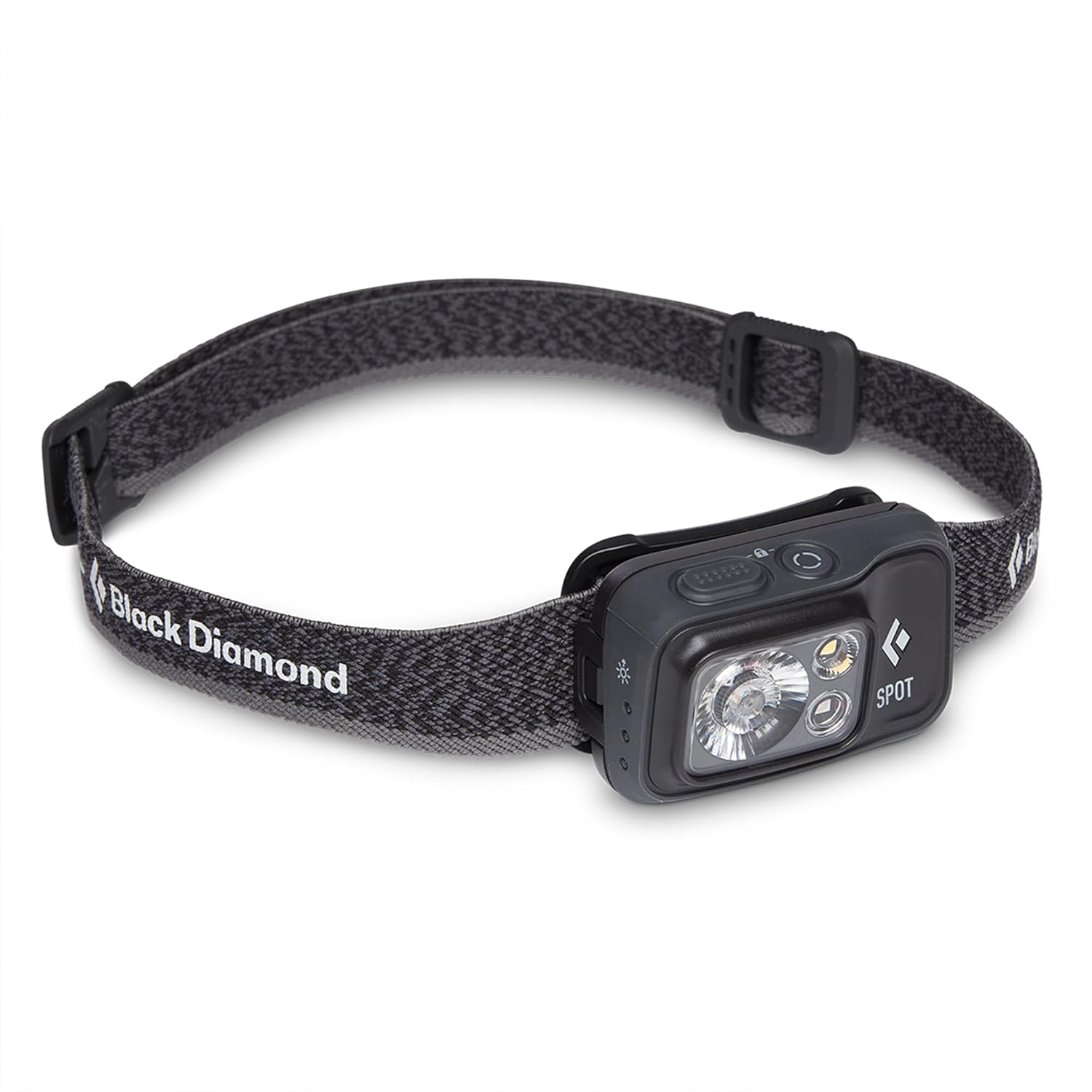
Black Diamond Spot 400 Headlamp
Price: around $50 | Lumens: 400 max | Weight: 3.1 oz | Battery: 3x AAA (included) | IPX rating: IPX8
The Spot 400 earns its position as the default recommendation for solo women hikers for three reasons beyond the spec sheet. First, the single-button interface — one click cycles through modes, hold activates the emergency strobe. You can operate it reliably with gloves on without memorizing a button sequence. Second, at IPX8 it is rated to 1.1 meters underwater for 30 minutes — the best waterproof rating in this price range. Third, the AAA battery format means you can resupply anywhere on earth. You are never stranded waiting for a USB port.
The 400-lumen maximum projects a beam 100 meters out, which is genuinely useful on technical trails after dark. The proximity/dimming mode steps down for camp use. The red-light mode is good, though not the best in class for hostel-specific use.
The one trade-off: AAA batteries are heavier than a built-in lithium cell. Over a week of evening use, you might go through one set of batteries — plan accordingly.
Who it’s for: The hiker who prioritizes reliability and field repairability over minimum weight. The pick for international travel, long backpacking trips, and anyone going somewhere USB charging is uncertain.
Pros: IPX8 waterproof, field-replaceable batteries, strong strobe, clean one-button interface, 200-hour runtime on low, solid 400-lumen max Cons: Heavier than rechargeable alternatives, no built-in charging port, not the lightest option
Petzl Actik Core 600L — Best High-Performance

Petzl Actik Core Rechargeable Headlamp
Price: around $65 | Lumens: 600 max | Weight: 2.9 oz | Battery: CORE rechargeable (USB) + AAA backup | IPX rating: IPX4
Petzl’s “Hybrid Concept” is the reason the Actik Core makes this list over cheaper rechargeable-only lamps: it runs on the included CORE lithium-ion battery for everyday use, but if you are three days into a backcountry trip with no power and the battery dies, you pull out three standard AAA cells and keep moving. The flexibility is not theoretical — it is the kind of redundancy that matters when you are alone.
At 600 lumens (the current version bumped this from earlier 450-lumen models), the Actik Core is significantly brighter than the Spot 400 for the same weight. The red-light mode includes a strobe option for emergency signaling visible up to 700 meters. The headband includes a reflective strip, which adds a passive visibility element when you are walking on a road.
The USB-C charging port on recent models is a useful upgrade over the older micro-USB versions. The fit on smaller head sizes is good — the band adjustment range accommodates down to approximately 52 cm without the lamp tilting.
Who it’s for: The hiker who wants maximum brightness, prefers rechargeable convenience for most trips, but will not compromise on having a backup power option.
Pros: 600 lumens, hybrid rechargeable/AAA design, reflective headband, USB-C, 700m strobe visibility, good head fit Cons: IPX4 (not fully waterproof), more expensive than the Spot 400, CORE battery requires managing charge before trips
BioLite HeadLamp 325 — Best for Comfort and Hostel Use

Price: around $45 | Lumens: 325 max | Weight: 1.75 oz | Battery: Integrated rechargeable (micro-USB) | IPX rating: IPX4
The BioLite HeadLamp 325 is the headlamp that serious reviewers wear all day and then struggle to describe the weight of, because at 1.75 ounces it barely registers. The design integrates the battery housing into the headband rather than mounting a box on the front — the result is a lamp that balances across your head rather than sitting like a diving helmet weight on your forehead.
For solo women traveling with a mix of outdoor and urban activities, the BioLite’s profile makes it the best hostel headlamp in this review. The low setting is genuinely low — soft enough to use as reading light at close range without waking a dorm. The 3D SlimFit headband adjusts down to smaller head sizes naturally and does not slip during trail running or hiking. The articulating front bezel lets you tilt the beam without moving your whole head.
At 325 lumens it is the least bright of the group, but for most camping, cooking, and hostel use this is entirely sufficient. The emergency strobe is present and accessible.
Who it’s for: The traveler who splits time between outdoor camping and hostel stays, runs or trail-jogs in the dark, or prioritizes day-long wearability. Also the strongest pick for anyone who has complained about headlamp headaches from front-heavy designs.
Pros: Lightest lamp in this review (1.75 oz), best day-long comfort, most natural head fit, genuinely low dim mode for hostel use, articulating bezel, rechargeable Cons: Lower max lumen output, micro-USB charging (not USB-C), IPX4 only, no field-replaceable batteries
 Photo by Simon Migaj on Pexels
Nitecore NU25 400 — Best Ultralight Pick

Nitecore NU25 400 Rechargeable Headlamp
Price: around $37 | Lumens: 400 max | Weight: under 2 oz | Battery: Integrated rechargeable (USB-C) | IPX rating: IP66
The Nitecore NU25 400 is the pick for thru-hikers, ultralight backpackers, and anyone weighing every gram. At under 2 ounces including the headband, it ties with the BioLite for the lightest designation — but the NU25 edges ahead on brightness (400 vs 325 lumens) and water resistance (IP66 vs IPX4).
The dual-beam design combines a spotlight and a floodlight that can run separately or together, which gives you real flexibility between a focused trail-finding beam and a wide camp-illumination beam. The USB-C charging recharges in about 1 hour, and runtime on medium mode is long enough for several evenings of use on a single charge.
The red-light mode with dual auxiliary LEDs is a genuine dim setting, appropriate for tent reading without disturbing a tentmate.
The primary limitation for solo safety use: the button interface requires more familiarity than the Black Diamond’s single-button simplicity. Under stress, the dual-zone controls take a moment of thought. Practice the strobe access before you need it.
Who it’s for: The ultralight backpacker, thru-hiker, or weight-obsessed traveler who wants maximum output for minimum grams at a budget price.
Pros: Exceptional weight-to-brightness ratio, USB-C fast charge, IP66 water resistance, dual-beam flexibility, under $40 Cons: More complex controls than the Spot 400, no field-replaceable batteries, smaller headband may not suit all head sizes
Black Diamond Cosmo 350 — Best Budget
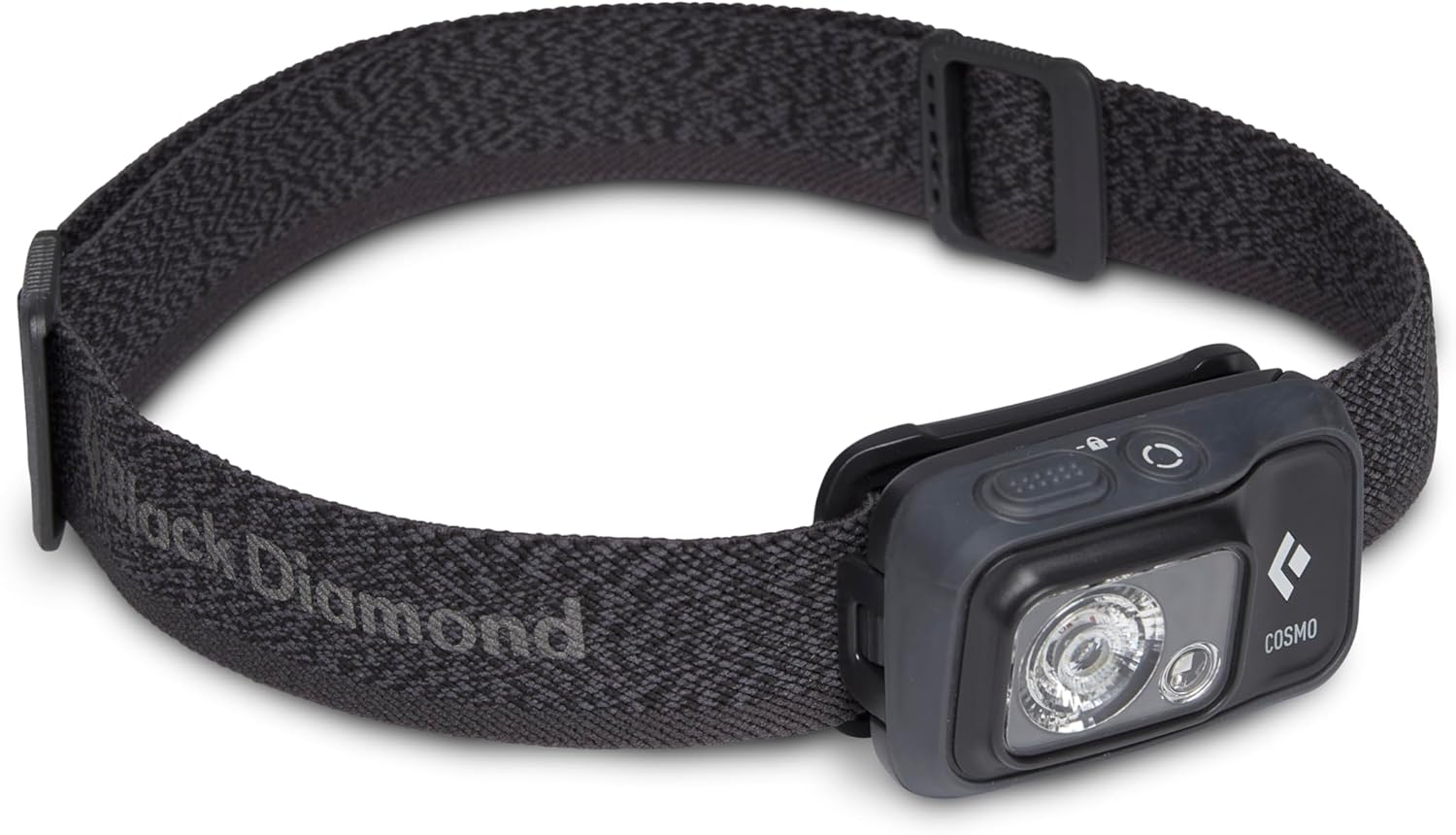
Black Diamond Cosmo 350 Headlamp
Price: around $30 | Lumens: 350 max | Weight: 2.9 oz | Battery: 3x AAA (included), or BD 1500 rechargeable | IPX rating: IPX8
The Cosmo 350 is the Spot 400’s smaller sibling, and it gives up only 50 lumens while costing roughly $20 less. For car campers, casual hikers, and travelers who want a headlamp for occasional use rather than every-night backcountry navigation, the gap between 350 and 400 lumens is invisible in practice.
Like the Spot, it runs on AAA batteries (included) with the option to use the BD 1500 rechargeable pack, carries the IPX8 waterproof rating, and uses the same clean Black Diamond interface logic. The proximity mode gives you soft, even light for reading in a tent or around camp.
The flood beam is genuinely excellent — wide, even, and dimmable to very low levels. For hostel reading, cooking at a campsite, and finding things in your pack, the Cosmo is hard to beat at its price point.
Who it’s for: Budget-conscious hikers and campers, travelers who want a reliable headlamp without the premium price, anyone buying their first serious outdoor headlamp.
Pros: Excellent flood beam, IPX8 waterproof, AAA field-replaceable batteries, lowest price in this review, same Black Diamond durability as the Spot Cons: 350 lumens means shorter effective throw than the Spot, no built-in USB charging (requires BD rechargeable battery add-on), slightly lower max brightness
Rechargeable vs Battery: The Honest Trade-Off for Solo Travel
The outdoor gear community has largely moved to rechargeable headlamps for good reason: lighter integrated batteries, USB charging that works with the same cable as your phone, and no need to carry spare batteries.
But for solo women travelers in particular, there is an argument for keeping at least a hybrid or battery option in the mix.
The remote-trip scenario: On a five-day hike without a power source, a pure rechargeable headlamp is a countdown timer. An AAA-compatible lamp means you can buy batteries at any tiny store in any country, extend your run indefinitely, and never make the choice between conserving light and seeing the trail.
The airport/ferry/long travel day scenario: USB ports in airports are reliable until they are not. A dead rechargeable headlamp at midnight, trying to find your way around a ferry deck, is exactly the situation you do not want.
The practical recommendation for solo women: if you primarily camp near facilities or do weekend hikes, pure rechargeable (BioLite or Nitecore) is the cleaner choice. If you do multi-day backcountry trips or travel to remote destinations where charging is uncertain, the Black Diamond Spot 400 or Petzl Actik Core hybrid is the more reliable system.
Head Fit: The Measurement That Matters
Average head circumference differs between men and women by about 2 centimeters. That gap sounds small, but it is enough to put standard headlamp fits at the edge of their adjustment range for many women — which means the lamp tilts, slips, or requires the band so tight it causes headaches.
When evaluating fit before purchase, look for:
- Adjustment range that reaches 52-54 cm — this captures the majority of women’s head circumferences without maxing the band
- Vertical tilt lock — the ability to click the lamp housing to a specific angle and have it stay there, independent of the band tightness
- Headband width at the rear — a wider rear strap distributes pressure and prevents the single-point “headband headache” after two or more hours of wear
Among the picks above, the BioLite HeadLamp 325 scores best on all three criteria due to its integrated-electronics band design. The Petzl Actik Core scores well on vertical tilt and adjustment range. The Black Diamond lamps have the most standard headband design, which is fine for most users but worth trying before a long trip.
 Photo by Kampus Production on Pexels
Quick-Reference Comparison
| Headlamp | Max Lumens | Weight | Battery | IPX | Price |
|---|---|---|---|---|---|
| Black Diamond Spot 400 | 400 | 3.1 oz | AAA | IPX8 | ~$50 |
| Petzl Actik Core | 600 | 2.9 oz | Rechargeable + AAA backup | IPX4 | ~$65 |
| BioLite HeadLamp 325 | 325 | 1.75 oz | Integrated rechargeable | IPX4 | ~$45 |
| Nitecore NU25 400 | 400 | under 2 oz | Rechargeable (USB-C) | IP66 | ~$37 |
| Black Diamond Cosmo 350 | 350 | 2.9 oz | AAA | IPX8 | ~$30 |
The Bottom Line
For most solo women hikers who want a single reliable headlamp that handles trail navigation, emergency signaling, and camp use, the Black Diamond Spot 400 is the recommendation — its waterproofing, field-replaceable batteries, and simple interface justify the price.
If weight is the priority, the BioLite HeadLamp 325 is the most comfortable headlamp available at any price, and its hostel-friendly dim mode is genuinely useful.
For maximum brightness with backup capability, the Petzl Actik Core hybrid system is hard to beat. And if you are on a strict budget, the Black Diamond Cosmo 350 gives you the same IPX8 rating and reliable interface as the Spot for $20 less.
What no headlamp will do: substitute for the safety apps and communication tools that should accompany any solo backcountry trip. A headlamp is part of the system, not the whole system.
For more solo camping and hiking gear guidance:
- Solo Female Camping Beginners Guide
- Solo Female Hiking in National Parks
- Best Safety Apps and Tech for Solo Female Travelers
Related Reading
Get price-drop alerts and new guides from HerTripGuide
One email a week: price drops on the gear we recommend, new guides, and what changed. No spam, unsubscribe anytime.